Money Buys Happiness. Here’s How:
WNDR · August 31, 2026
From the founders of Chaser.
Trends That Are Silent, Why Can’t We Ignore Them
We have always been trying to represent feelings and meanings with “simpler” representations. In our previous iteration, How Nightlife Will Save Gen Z, Dhruv said “analog and physical spaces will increase their value in the long run.” I’d like to dive into this from an engineering perspective.
We are always trying to create a digital representation of analog signals; continuous things like sound, electricity, things that are hard to represent. Each time we do this, we convert it into a number, a simplified representation. But you always lose some of the original meaning.
It’s a well-known trade-off, to represent something so complex, in its raw form, in a simplified, more digestible manner. The issue is: when it matters, you can’t skip out on accuracy for simplicity.
A real example of this is autonomous vehicles. When you ride in a Waymo, a Zoox, you name it, it’s making 100s of thousands of calculations in real time. Whether it’s deciding when the car should stop, or when to turn the sound down because there’s an emergency outside, the accuracy of that calculation matters. At the end of the day, it’s still all estimation.
Modeling life is not simple. It never will be.
Is Any Phrase Timeless
Have you noticed the trend of baggy pants, wired headphones, cargo pants, capris, all making a comeback? I’ve heard it described as performative before. But it’s a style that represents a time where there was less modeling of life, just life itself. A pre-digital form.
It’s interesting that this trend is reappearing.
Why now? We have advanced so much in technology.
Why now? At a time where over-optimization of your life is deemed “key.”
Why now? When the economy is forcing people to only spend on their needs, never their wants.
My hypothesis:
When people can’t afford to buy their way into feeling okay, they go looking for it somewhere free: real rooms, real people.
So does money really buy happiness, or is it just a mechanism to increase your ability to interact with others?
Alt: Money Augments Happiness.
Nightlife Is Struggling from Modeling Life
As we (founders) continue interacting with our customers, a common theme is emerging in each market. Bar sales are down year on year, with only a few venues able to show a positive increase.
Managers are pointing to different things.
“People just aren’t drinking as much.”
“People would rather stay in and rot.”
“People are having a hard time affording the essentials, much less spending money on fun.”
This Has Happened Before
None of these are the wrong answer. They’re just the surface of it.
People aren’t drinking less because they stopped wanting to go out. They’re drinking less because whatever’s left after rent, groceries, and gas has to work harder than it used to. It has to actually deliver something. That’s the same modeling problem from the top of this piece, just playing out in a different signal.
This has happened before. Every time a generation gets pushed to an extreme: over-optimized, over-tracked, over-digitized, it runs out of runway and swings back. That’s not a phrase trend. That’s not a pant. That’s the timeless part.
Why now? Because pendulums don’t stop when they hit the edge. They swing back.
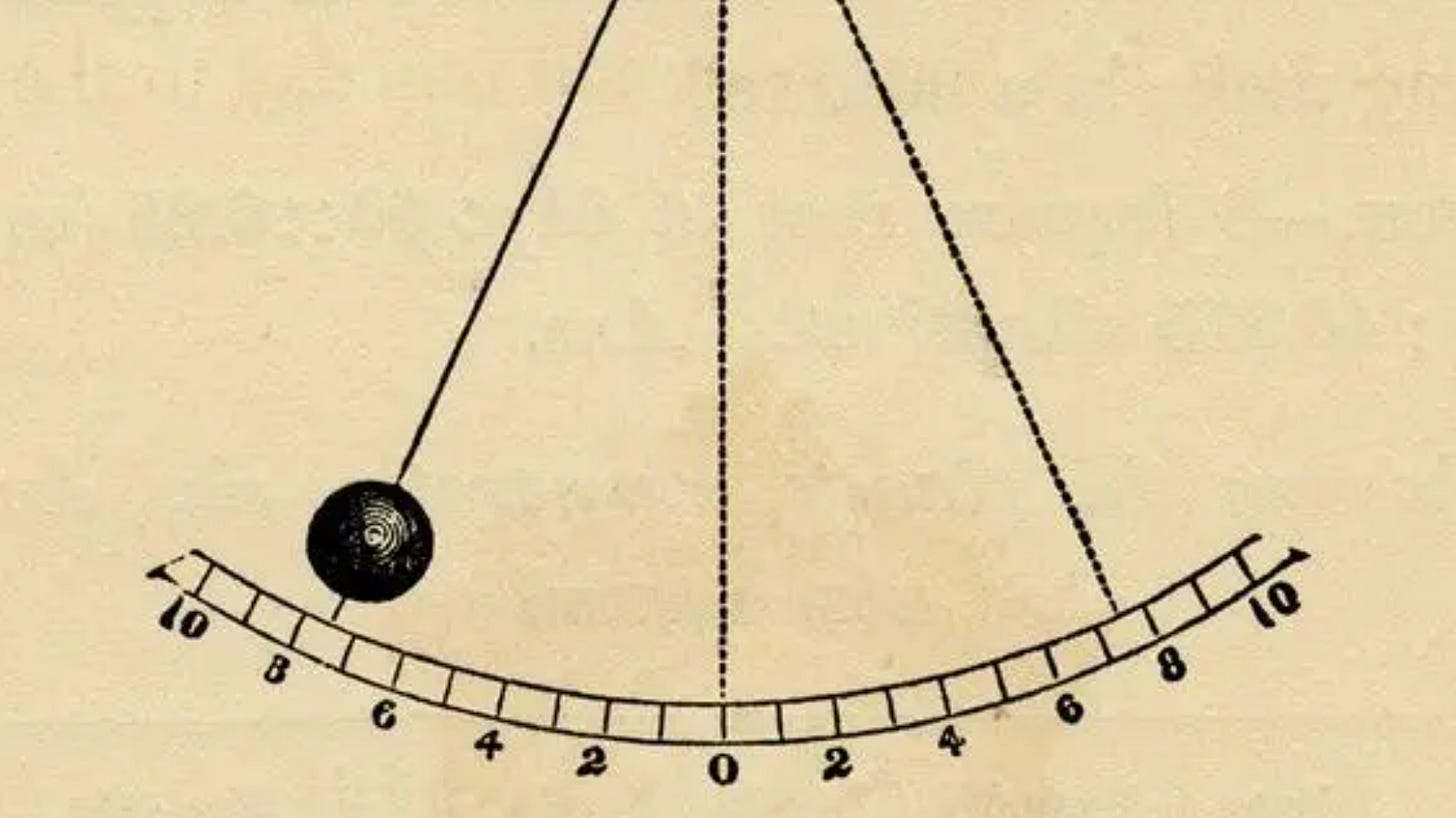
And the swing back always lands in the same place: less modeling, more raw signal. Real rooms. Real people. The bars that are down aren’t losing because people stopped wanting a night out, they’re losing because they modeled the experience down to a number: a cover charge, an upsell, a playlist built for turnover. The bars that are up haven’t done anything complicated. They kept the raw form. You’re still a regular there, not a transaction.
So, back to the question: does money buy happiness?
Not directly. Money augments happiness, it’s the mechanism that lets you keep showing up for the real thing when the real thing costs something. That’s the gap we’re building Chaser to close. Not by making nightlife cheaper, but by rewarding the people already showing up for being exactly that, present.
The correction has already started. We’re just building for the other side of it.
- gil